

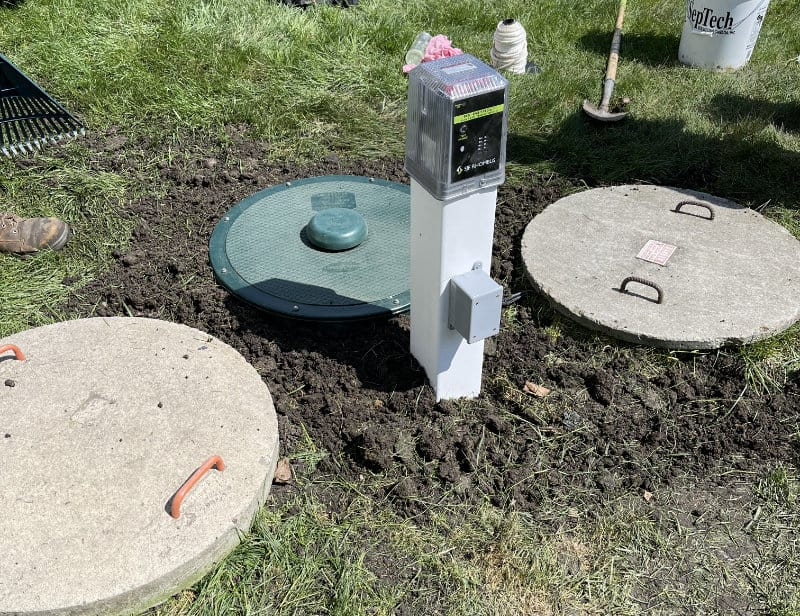
It usually happens at the worst possible hour. A buzzer somewhere outside, or a red light blinking on a box mounted near the back door, and four people in the house all asking what that noise is.
Here is the short version: you have time, but not much of it. That alarm is a float switch telling you the liquid level has climbed to a preset height, and the clock on holding tank pumping started the moment it tripped. What you do in the next hour determines whether this stays an inconvenience or turns into raw sewage on your basement floor.
What does a holding tank alarm actually mean?
The alarm means a float inside your tank has risen high enough to close a circuit, usually when the tank hits somewhere around 75 to 80 percent of capacity.
That threshold exists on purpose. Installers set the float below the inlet pipe so you get warning while there is still usable space left, rather than at the moment of overflow.
A holding tank is different from a septic tank, and the difference matters here. A septic system discharges treated effluent to a drain field, so it self-regulates to a degree. A holding tank has no outlet. Everything that goes down your drains stays in that tank until a truck removes it. When it fills, it backs up into the lowest fixture in your house.
Most alarm panels have a silence button and a test button. Silencing the horn does not lower the level. People forget this more often than you would think, hit the button, and rediscover the problem three days later.
What should you do first?
Cut your water use immediately, then call for service. In that order, because every gallon you send down a drain after the alarm sounds shortens the window you have.
Practical steps for the first hour:
- Stop laundry and dishwasher cycles, including anything mid-run
- Keep showers to a couple of minutes, or skip them
- Follow the old rule on flushing and leave liquid waste alone between uses
- Check that no toilet is running silently, since a stuck flapper can add hundreds of gallons a day
- Confirm the alarm is a level alarm and not a pump fault, if your system has a pump
Then call. When you do, have three things ready: your tank size in gallons if you know it, roughly how long ago it was last pumped, and how many people are currently in the house. That lets the dispatcher judge urgency instead of guessing.
Do not open the tank lid to look. Holding tanks generate hydrogen sulfide and methane, and the gas above the liquid can incapacitate someone in seconds. Every year people are injured looking into a tank they thought was safe.
How long do you have before it overflows?
Most households have somewhere between one and three days, and the variable that decides it is how many gallons per day your household actually uses.
Run the arithmetic on your own situation. A typical person uses 50 to 70 gallons a day with normal habits. A family of four is therefore putting 200 to 280 gallons into that tank daily. If your tank is 1,000 gallons and the alarm trips at 80 percent, you have roughly 200 gallons of space left, which is about one day at normal use.
Cut consumption hard and you may stretch that to two or three days. Ignore the alarm and run a couple of loads of laundry and you could be at overflow before dinner.
Winter changes the calculation in Kansas. Frozen ground and drifted snow can slow truck access to rural properties, so the practical response time may be longer in January than in June. Searching for holding tank pumping near me during an ice storm is a worse position than scheduling ahead of one.
Why did it go off with no warning?
Alarms feel sudden because the warning system is binary, and because household water use is rarely as steady as people assume.
Common reasons a tank fills faster than expected:
- Guests staying over, which can double daily volume overnight
- A leaking toilet or dripping fixture adding gallons quietly around the clock
- Sump pump or downspout water improperly routed into the tank
- Groundwater infiltrating through a cracked lid seal or riser joint after heavy rain
- The last pumping was less complete than it should have been
That infiltration point deserves attention. If your alarm has been going off sooner each cycle without any change in how you live, water is very likely getting in from somewhere it should not, and pumping more often only treats the symptom.
Float switches also fail. If the tank was pumped recently and the alarm is sounding again, the float may be stuck on debris or the wiring may be corroded. A technician can check that during the service call.
How do you avoid this next time?
Get on a schedule instead of waiting for the buzzer, because a scheduled pump-out costs less than an emergency one and it never happens at 11pm.
Work out your interval from your own numbers. Take your tank capacity, multiply by 0.75 for usable volume, then divide by your household’s daily gallons. A 1,000 gallon tank serving two adults at roughly 120 gallons a day comes out around six days of capacity. That same tank with a family of five is closer to three.
Once you know the interval, put it on a recurring calendar and adjust after a couple of cycles based on what actually happens.
A few habits stretch it. Fix running toilets the week you notice them. Install low flow fixtures, which meaningfully reduce volume without changing how anything feels. Space laundry across the week rather than doing six loads on Saturday. Keep roof and surface drainage away from the tank lid.
And test the alarm twice a year. An alarm that has quietly stopped working gives you no warning at all, which is a much worse morning than the one you are having now.
Downing Septic has handled septic, holding tank, and grease work across Northeast Kansas for more than twenty years, with technicians available around the clock for calls that cannot wait until Monday.
Alarm going off right now, or want to get on a schedule before it does? Contact Downing Septic or call 785-357-0046.