 We Are Hiring! Plumbers, CDL Drivers & Laborers


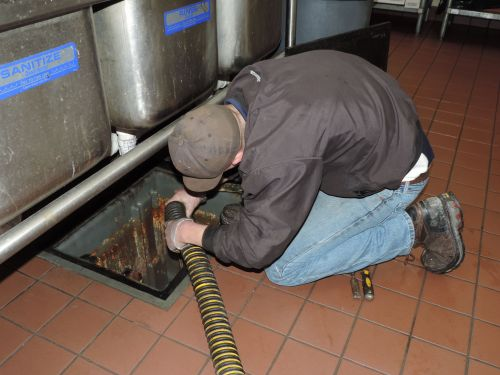
Your dish pit backs up on a Friday at 7pm with a full dining room. That is when most operators start typing grease trap cleaners near me into a phone, and that is the most expensive possible moment to be looking.
The schedule that prevents that night is not complicated, and it is not the same for every kitchen. A 500 seat steakhouse and a coffee shop with a panini press do not belong on the same interval, even if their traps are the same size.
How often should a restaurant pump its grease trap?
Most commercial kitchens need grease trap pumping every one to three months, with high volume operations running closer to monthly and low volume ones stretching toward quarterly.
The frequency depends on four things: how much you cook, what you cook, how big the trap is, and what your local authority requires.
Rough guidance by operation type:
- High volume, heavy fry or grill: every 30 days, sometimes more often
- Full service restaurant, moderate volume: every 30 to 60 days
- Cafe, bakery, or limited menu: every 60 to 90 days
- Small under-sink interceptor: often every 2 to 4 weeks regardless of volume, because capacity is tiny
Undersized traps are the trap, so to speak. A 20 gallon under-sink unit in a kitchen that should have a 1,000 gallon outdoor interceptor will need service constantly and will still fail during rushes. If you are pumping every two weeks and still seeing backups, the equipment is wrong for the kitchen rather than the schedule being wrong.
What is the 25 percent rule?
The 25 percent rule is the industry standard that says a grease trap should be pumped once fats, oils, grease, and solids reach a quarter of the trap’s total capacity.
Many municipal codes reference it directly, and it is what an inspector is likely to measure against.
The reason behind it is mechanical. A grease trap works by slowing wastewater enough for grease to float and solids to sink, leaving relatively clean water to exit through the outlet. Once the accumulated layers occupy a quarter of the volume, the water moves through faster than it should and grease starts passing straight out into the sewer line.
You can check your own trap between services. Use a dipstick or a length of dowel to measure the grease cap thickness and the sludge on the bottom, and compare the total against the trap’s depth. Do that a few times and you will know your real interval instead of guessing.
Write those measurements down. A log of levels over several months is genuinely useful, and it also demonstrates to an inspector that you are managing the system rather than reacting to it.
What happens if you wait too long?
Overdue traps cause problems that escalate quickly from operational to regulatory to structural.
The first thing you notice is odor. Grease sitting too long turns anaerobic and produces hydrogen sulfide, which is the rotten egg smell customers detect long before you do because you have stopped noticing it.
Next comes slow drainage, then backups, then a closed kitchen. A backup during service costs you the night’s revenue plus whatever the emergency call runs, and emergency pricing is not scheduled pricing.
Then there is the regulatory side. Kansas municipalities take FOG discharge seriously, and a trap that has been passing grease into the sewer can bring fines from the local water authority. Repeated violations invite closer attention, and health inspections in some jurisdictions include grease trap condition.
Hydrogen sulfide also attacks concrete and steel over time. A trap left neglected for years can require replacement rather than cleaning, and replacing an in-ground interceptor means excavation, permits, and downtime.
The sewer line between your trap and the main is the other casualty. Grease that gets past the trap cools and hardens on the pipe walls, narrowing the line a little more each month until a section needs jetting or replacement.
Do enzymes and additives replace pumping?
Additives do not remove grease from your trap. They change its form, and that can make things worse downstream.
Emulsifiers and some enzyme products break grease into smaller droplets that stay suspended in the water column. Inside the trap, that means the grease no longer separates and floats where it can be captured. It flows out with the effluent instead, which is exactly what your trap exists to prevent.
Many municipalities prohibit emulsifying additives for this reason. Check your local code before you buy anything a salesperson recommends.
Bacterial products have a narrower legitimate use for odor control and for line maintenance in some situations, though they still do not reduce the volume that has to be physically removed. Grease and solids leave the trap in a truck or they do not leave at all.
The practices that genuinely extend your interval happen upstream in the kitchen:
- Scrape plates and pans into the trash before they reach the dish pit
- Collect fryer oil in a rendering barrel rather than pouring any of it down a drain
- Use strainers on every sink and empty them into solid waste
- Dry wipe greasy cookware before washing
- Train new hires on this during their first week, because most violations are habits rather than decisions
What records should you keep?
Keep a manifest for every pump-out, because most Kansas municipalities require documentation that the FOG was disposed of properly and inspectors ask for it during compliance checks.
Your service provider should issue that manifest each time. It should show the date, the volume removed, the hauler, and the disposal site.
Worth keeping alongside it: your own trap measurement log, records of any repairs, and the trap’s size and installation date. If you ever change providers or face a compliance question, that file answers most of it immediately.
Store it somewhere a manager can find it during an inspection rather than in a drawer only the owner knows about.
One more reason the file matters: if you ever need to compare quotes for grease trap pumping near me, a documented history of volumes removed is what lets a new provider price the job accurately instead of guessing high.
Downing Septic has serviced grease traps and interceptors across Topeka, Lawrence, and the surrounding region for over twenty years, with licensed installers on staff for repairs and new equipment.
Want a pumping schedule matched to your kitchen’s actual volume? Set up grease trap service with Downing Septic or call 785-357-0046.